Regulated Experience (Rx): Describing it, Distinguishing it, and Defining it

This guest editorial for the ANZSOG-auspiced National Regulators Community of Practice (NRCoP) has been written by Dr Grant Pink, RECAP Consultants and Pracademic Advisor to the NRCoP and Rob Warner, Chief Advisor Strategy, Maritime New Zealand.
Regulators will have great difficulty in building and maintaining regulatory capability unless they have a clear and practical understanding of what Regulated Experience (Rx) is – as Rx impacts on regulatory practice, regulatory delivery, and regulatory outcomes.
Customer Experience (Cx) and User Experience (Ux) have become well recognised and established frameworks for designing and evaluating customer service and service delivery, whether provided by public or private organisations.
The authors believe that the unique nature of regulatory relationships requires a distinct framework, and one that the authors believe should be called or referred to as Regulated Experience (Rx).
The Rx framework acknowledges that ‘regulated entities’ are not ‘customers’ or ‘clients’ in the traditional sense. That is not to suggest that there may not be circumstances or situations where it may be mutually beneficial for regulators to apply appropriate service delivery and service design principles, in order to achieve or advance regulatory outcomes.
The authors have noticed a resurgence in the implicit or implied use of the term ‘customer’ and ‘client’ by regulators, in both spoken and written communications.
What to call those that are subject to regulation, and how to describe the experiences that they are likely to encounter, has been a recurring topic. For example:
- 25 years ago, in 2000, Sparrow made a critical distinction, stating that:
‘[t]he important features that distinguish regulatory and enforcement agencies from the rest of government ... [is that] [t]he core of their mission involves the imposition of duties. They deliver obligations, rather than services’;[i]
- Eight years ago, in 2017, Wauchop and Manch stated that:
‘... regulatory staff in organisations with broader functions where a ‘customer focus’ mantra is embraced can feel disenfranchised and limited in their ability to do their jobs effectively;[ii] and
- Recently, in 2022, the New Zealand Government Regulatory Practice Initiative (G-Reg) convened a panel on the topic of ‘Are Regulated Parties Customers?’[iii] Panellists discussed why it is important to consider what regulators call those that are regulated, with a key theme being how words and descriptors can:
- shape – the way regulators think and act; [iv]
- set – the tone for regulatory interactions and behaviours; [v]
- signal – and can define organisational culture; [vi] and
- structure – how regulators approach problems. [vii]
Given the unique nature of what can constitute ‘regulatory relationships’ and form part of ‘regulatory eco-systems’, the authors believe that a greater understanding, appreciation, and application of Regulated Experience (or Rx) is required. Therefore, the authors believe that now is an appropriate time to purposively describe, distinguish, and define Rx.
A critical first step is being able to describe what Rx is, and what Rx is not, and detail where it intersects with, extends, and differs from Cx and Ux.
In recent times Customer Experience (Cx) and User Experience (Ux) have become ubiquitous in the public service. While Cx and Ux clearly have their place they are not always fit for purpose, and in fact can be problematic, when used in specific regulatory contexts.
There are a number of key distinctions between Cx, Ux, and Rx, but in this introductory article the authors will focus on the core distinction – which relates to the nature of the relationship.
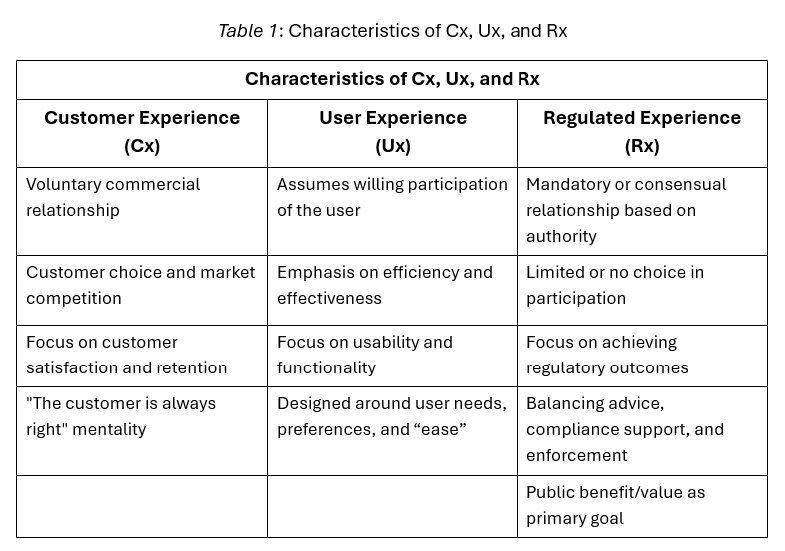
A second step involves distinguishing Regulated Experience from:
- ‘Regulator experience’ – which relates to the experience of the regulator and its staff, this is often referred to in terms of regulatory capability, regulatory competence, and regulatory maturity; and
- ‘Regulatory experience’ – which relates to the experience that someone, who is not a regulated entity, has when their activities intersect with a regulated system or systems. In certain circumstances and situations ‘regulatory experience’ may share similarities with Ux.
The third step relates to the need for a baseline working definition. The benefits of this is that it creates a solid foundation from which future discussions, research, and iterations can be based upon.
The authors define Regulated Experience (or Rx) as:
‘the experience that a regulated entity has when they are involved in or subject to regulatory processes, activities, and oversight, where they or others have specific regulatory duties and obligations – as distinct from the experiences that a person or entity has when they are a customer or client’.
Rx recognizes the unique nature of regulatory relationships, while incorporating appropriate elements of modern service design (which may be customer - or client- like) and therefore include or incorporate Cx and Ux aspects where appropriate.
To be clear:
- Rx is not a fixed concept but instead it occurs across a spectrum;
- Rx design should be considered, intentional, tailored to the specific regulatory context and goals;
- Rx offers a distinct framework for designing and evaluating regulatory interactions; and
- Rx helps:
- regulated entities, stakeholders, and the wider community – to be clearer about the nature of their relationship, and their associated regulatory duties and obligations, and therefore what their expectations could or should be; and
- regulators – to be more aware of the complex and inter-animated four-way interaction[viii] between regulator, regulated, stakeholders, and wider community – especially as it relates to maintaining an appropriate professional distance while still delivering efficient and effective regulatory services that achieve public benefit outcomes.