




In conversation in Hobart: How does AI lift public sector productivity without losing purpose?
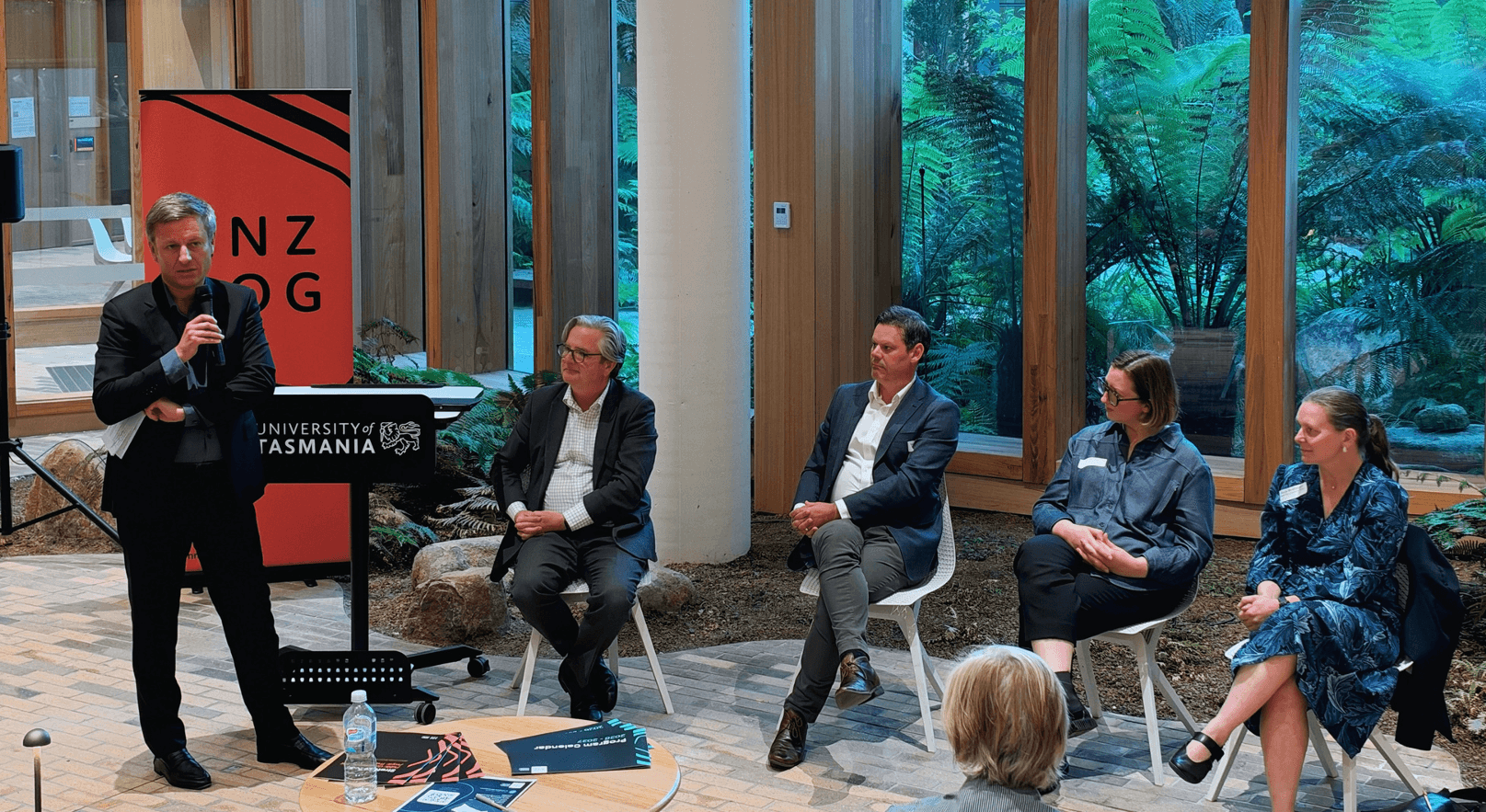
The rise of AI is already delivering efficiencies and savings in the public sector, but how can governments ensure that they don’t lose sight of human values and purpose?
A recent ANZSOG Thought Leadership event ‘Productivity with Purpose’ held at the University of Tasmania in Hobart – ‘explored how AI is being used to change ways of working and improve productivity, while focusing on how public services and universities can use it to enhance their core role of delivering public value.
The event was led by Mathew Healy, Deputy Secretary, Strategy and Delivery, Tasmanian Department of Premier and Cabinet, with a panel of three experts:
• Alicja Mosbauer, Assistant Secretary, Chief Data Office & Chief AI Officer, Commonwealth Department of Veterans Affairs
• Bonnie Shaw, Co-Founder & Chief Strategy & Impact Officer of Place Intelligence
• Mark Bowles, Head of the Tasmanian School of Business and Economics and former Tasmanian public servant
The panel examined how AI can increase or reduce public trust in government, how leaders can give their staff permission to innovate, and how we decide when a human needs to make a decision.
Mr Healy opened the discussion by saying that he hoped AI would be able to help public servants improve their delivery of services to the Tasmanian community, and get better outcomes from the resources they had available.
He also posed the question of whether governments could be confident that ‘AI is genuinely improving productivity as opposed to just generating a hell of a lot more activity’.
AI is an enabler that can free people to do higher-value work
All panellists spoke of the need to consciously "ring fence" activities where judgement, context and human interaction were of primary importance, rather than focus solely on efficiency.
Ms Mosbauer outlined how the Department of Veterans' Affairs was trialling an AI document reader to help process complex veterans' compensation claims. It does not replace human decision-making, but searches medical evidence, identifies missing information and makes relevant material easier for staff to find. Early trials suggest parts of the process can be completed two to three times faster, while reducing the cognitive burden on staff.
“Part of the journey has been this story of it's always been built by staff for staff. This is something staff asked for and they wanted and, and now they're excited that they're on the pilot and they can see some huge benefit,” she said.
“For them it really is being able to then respond to the veteran in a much more coherent way.”
Ms Shaw said that local councils were early innovators and moving to streamline processes using AI. She said governments had an obligation to work out how they could use AI tools and technologies to improve delivery, so that citizens had less friction when accessing services.
“That's not to say that there isn't cyber risk and there aren’t other things that we have to address along the way. But you have to think about the risk of not acting with this technology and the risk of government being left behind.”
She said that governments needed to do more to encourage employees to innovate with AI.
“If you're in a senior leadership position, enable the staff provide an authorising environment that gives them the safety to know that they can get in there and do this,” she said.
“It's very easy now to get in and play around with it. If you're going to be using these tools in a public system and interacting with regulatory and legislative environments, or doing policy work or service delivery. You actually need to understand what's under the hood and the kind of water that you're swimming in.”
When being human matters
Mr Bowles said that even in the last two years the use of AI in government had grown and had huge potential for efficiency.
“I was involved in particularly complex big infrastructure projects where you've got to be able to synthesise a lot of legal information - policy, information economics areas that really would require whole team of different specialists - where now you can do a really good job with an AI agent,” he said.
“I think this is a really interesting question for not just government but all knowledge intensive organisations: how much do you get the machine to do and how much do you still rely on intelligence and the knowledge of your own staff?
Mr Healy summed up by saying that AI needed to be used to supplement human empathy and judgement
“AI needs to be a tool that we can use to focus on how we deliver services to people. AI is the enabler and may deliver productivity, but we as humans, are the ones that will have the purpose,” he said.
Five things we learnt from Productivity with Purpose
1) Keep the human connection: Use AI to strengthen human interaction, not replace it. AI can reduce the administrative burden leaves more time for connection that communities value.
2) Automate the task not the person: AI can take on repetitive and cognitively demanding work, while people focus on relationships and judgement.
3) AI capability is built through practice: Public sector leaders can create supportive environments for staff to experiment, learn and build confidence.
4) You don’t have to automate everything: Organisations need to deliberately protect the moments where humans build and maintain public trust.
5) Productivity with Purpose: Productivity is not just about doing more with less. It is about using the resources we have to deliver greater public value
ANZSOG’s next Thought Leadership event is the upcoming Bridge Live webinar: Understanding Privilege in Public Institutions, which is being held from 12-1pm (AEST) on Tuesday 17 November. This free online event will see Maria Katsonis, curator of ANZSOG’s The Bridge, discuss the ANU’s privilege toolkit with toolkit developer Associate Professor Ashley Schram, Dr Lisa Conway and Mind Australia director Tim Heffernan. Bridge Live is free but you will need to register here to take part.