Can governments be stable and agile at the same time?

This research brief was published through ANZSOG's The Bridge newsletter, which connects academic research with public sector practice. It provides a concise summary of a piece of research relevant to public sector professionals.
An article in Policy Design and Practice presents a market-shaping concept of the public sector that explores how governments can balance stability and agility while driving complex transformations.
Conventional approaches focused on correcting market failures and improving efficiency are inadequate for guiding transformations in climate policy, care systems and industrial renewal. The article reconceptualises the state as a proactive shaper of markets and presents a three-layer framework comprising structural capacities, organisational routines and dynamic capabilities. Together, these elements help explain how governments create public value while remaining both stable and adaptable.
From market failure to market shaping
Market failure theory (MFT) has dominated how public administration understands the role of the state in the economy. It justifies government intervention when market failures prevent markets from operating efficiently. These failures include public goods, negative externalities and information asymmetries.
By treating the state as a corrector of market inefficiencies, MFT overlooks a key question:
How should the public sector be organised to take risks, sustain long-term investment and work with others to create public value in conditions of uncertainty?
Governments do much more than regulate markets or redistribute resources. They also directly produce public value by delivering essential services and operating critical infrastructure. Recognising the state as a producer of public value has implications for how public organisations are structured and managed. Effective public service delivery requires internal capabilities. A market-shaping theory of the public sector places rebuilding government’s capacity to produce public value at the centre of strengthening state capacity.
Public sector capacities and capabilities
The article proposes that mission-oriented governance requires dynamic organisational capabilities oriented toward sensing, experimenting and co-creating markets over time. This has three interdependent layers as shown in Figure 1.
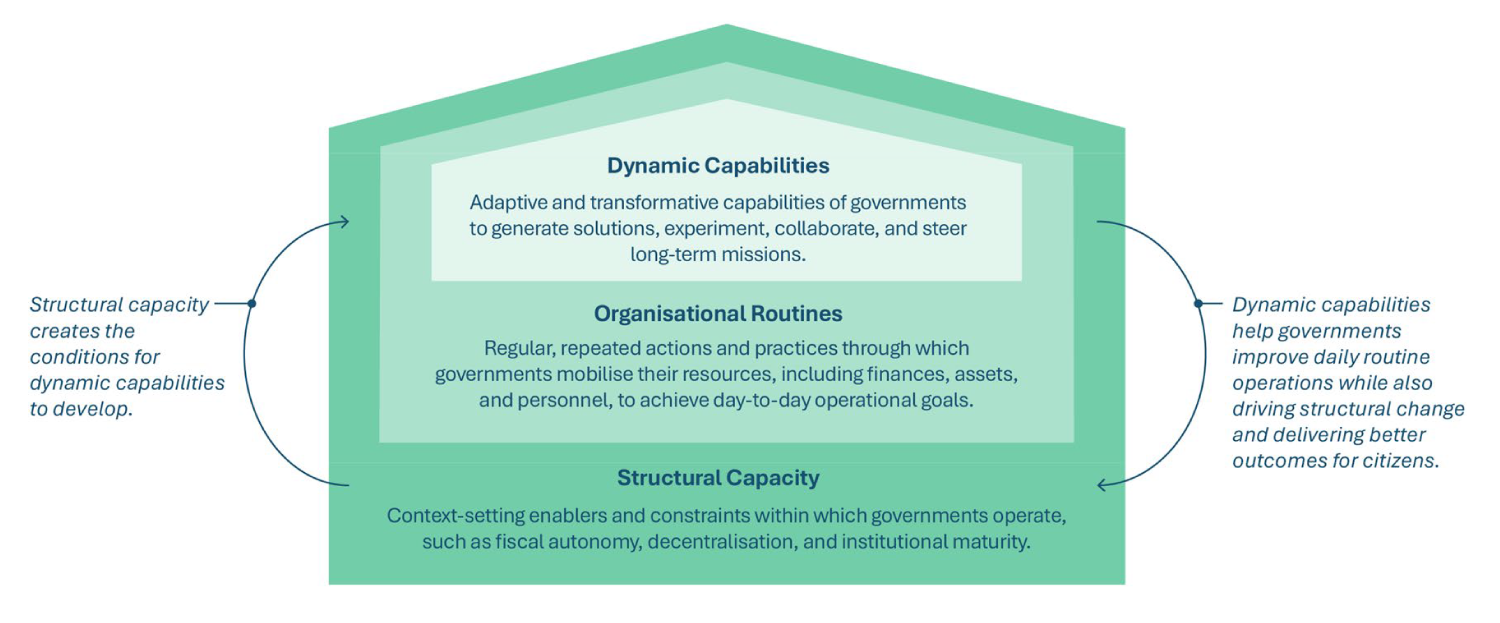 Figure 1: Three layers of public sector capacity and capability (Mazzucato and Kattel 2026)
Structural capacity refers to the institutional architecture, the resource base and the governance setting in which public organisations operate. These are the funding arrangements, civil service systems, and long-term planning tools that enable direction-setting. Structural capacity is a precondition for the other layers. Without it, dynamic capabilities remain fragile and learning does not accumulate into institutional change.
Organisational routines are the recurring, professionalised practices by which public organisations carry out their work. They embody tacit ways of defining problems, negotiating priorities, and producing value.
Dynamic capabilities refer to the ability of public organisations to sense emerging opportunities and risks and adapt strategies over time.
The interaction between structural capacities, routines and dynamic capabilities
These three layers are interconnected and influence one another. Structural capacities provide the authority and resources needed to support cooperation and experimentation. Organisational routines translate these capacities into coordinated action, ensuring that policy commitments lead to practical outcomes. Dynamic capabilities build on this foundation, using feedback and learning to help organisations adapt to uncertainty and change.
The relationship also works in reverse. Successful experimentation can inform new policy instruments and structural reforms, strengthening the public sector’s capacity over time. Conversely, declining budgets and staffing can weaken organisational routines, disrupt learning and erode accumulated capabilities. The table below illustrates these interactions.
Relationship | Reinforcing mechanism (capability building) | Weakening mechanism (capability loss) |
|---|---|---|
Structural capacities → Organisational routines | Clear missions, dedicated budgets, and coordinating bodies enable routines that support collaboration and problem-solving. | Mandates exist only on paper; routines revert to compliance, risk aversion, or siloed delivery. |
Organisational routines → Dynamic capabilities | Feedback loops, milestone-based review, and shared learning normalise adaptation of strategies. | Learning remains episodic; experimentation occurs at the periphery rather than in core delivery. |
Dynamic capabilities → Structural capacities | Successful experimentation is codified into policy instruments, regulatory reforms, or redesigned organisational structures. | Experimental results remain uncodified; lessons are lost with turnover; strategic direction fragments over time. |
This interaction challenges the traditional view that stable bureaucracies and agile ways of working are incompatible. Stability and adaptability are not opposing goals but can reinforce one another when organisational structures, established routines and continuous learning work together.
The bottom line
A market-shaping approach highlights that governments need more than policy ambition to deliver complex change. They also need the institutional capacity, routines and learning systems that allow them to remain both stable and adaptable over time. The three interconnected layers of structural capacities, organisational routines and dynamic capabilities reinforce one another and enable governments to achieve both stability and agility.
Want to read more?
The market shaping state: capacities and capabilities for a new generation of mission-oriented policies – Mariana Mazzucato and Rainer Kattel, Policy Design and Practice, October 2026