ANZSOG research examines leadership trends that align with unique public sector needs

There is an abundance of ideas and models for effective leadership, largely influenced by private sector experience. Public sector leadership is distinct, and leadership development is hard to get right. A new ANZSOG Research paper finds a shift towards more collaborative and relational approaches and how it aligns with contemporary public sector leadership needs.
What is effective public leadership and what is needed next?, co-authored by Lisa Carson and Julia Richardson, provides a high-level synthesis of academic literature to help governments, and learning and development (L&D) professionals, make informed decisions about staff and organisational development.
The report is the third in a series of ANZSOG leadership reports completed late last year and outlines recent shifts in leadership thinking, the complexities of deciphering what is ‘most effective’ in leadership, and offers suggestions for practice, particularly around relational leadership and the ‘Wallace 2D Framework’.
It finds that there are a range of areas and issues of practical relevance that appear to be missing or overlooked in the leadership development literature. These include leading at and across all levels, digital and virtual leadership, intersectionality, non-western perspectives, newer strands (such as entrepreneurial leadership), evidenced based leadership development and impact into practice
Ways to encourage collaborative governance and relational leadership
The work of the public sector is changing towards a collaborative governance paradigm that requires a change in leadership approaches. This includes viewing leadership as a collective process in which everyone helps to define, recognising that success depends on the quality of connections between leaders and their groups. Relational leadership is a mindset that matures a deeper understanding of the purpose and boundaries that define the public sector. Championing leadership development should prioritise these principles.
What does effective leadership look like in this environment? The report states that:
‘Effectiveness’ is a contested concept that is difficult to define, interpret, assess and compare. There is a need to move beyond outdated, re-packaged ‘zombie leadership’ approaches and instead adopt perspectives that broaden our understanding of leadership beyond individual leaders.
The report outlines how public sector leadership has changed in response to the new environment, with an emphasis on systems, leadership behaviours and relational understanding.
The shift to a whole-of-organisation or ‘systems’ approach has occurred in response to the limitations of traditional methods in dealing with the complexities of the modern public sector. Traditional models often failed to account for the dynamic and interconnected nature of public sector challenges, leading to inefficiencies and missed opportunities for innovation.
As organisations and systems grow in size, complexity and diversity of expertise, there is an increasing emphasis on identifying and cultivating the specific leadership behaviours and capabilities necessary to meet evolving needs in an uncertain environment, and to move away from traditional hierarchical models. Public expectations for transparency and ethical leadership have also highlighted the importance of adaptive, responsive, and effective leadership behaviours in driving organisational success and meeting the demands of modern public administration.
Relationality is at the heart of responding to these demands. A relational approach to leadership development emphasises the cultivation of leadership as a ‘collective phenomenon that is shared among people’ with leadership skills developed through interpersonal relationships, teams, networks and organisations.
To address the limitations of traditional approaches to leadership development, one approach which has been identified as focusing more on relational aspects of leadership is the ‘Wallace 2D Leadership Framework’.
The framework moves away from linear approaches to leadership development and outlines three levels of leadership: self-leadership, competency-based leadership, and mindset-based leadership, integrated with personal motivation, skill acquisition, and holistic leadership values.
Figure 1: The Wallace 2D Framework as adapted by Hastings et.al, 2026
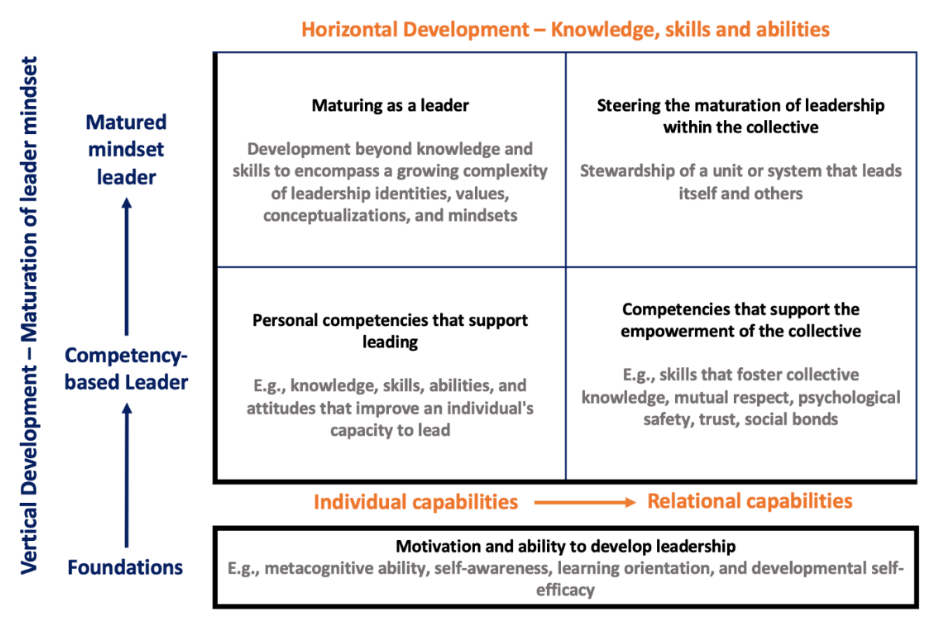
In this framework, vertical development focuses on the evolution of adult cognition, crucial for modern leadership in complex, interconnected environments. It is adopted from leadership science that links mature mindsets to organisational success. Horizontal development contrasts individual leadership (directing and managing) with relational leadership (promoting collective action and empowerment), emphasising environments where team members can thrive.
Many other current approaches to leadership also emphasise the relational. For example:
Transformational leadership focuses on inspiring and motivating followers by fostering strong emotional connections and shared vision.
Servant leadership emphasises serving others, prioritising the growth and well-being of team members and communities.
Participative (democratic) leadership involves team members in decision-making processes, promoting collective responsibility and open dialogue.
Collaborative leadership brings diverse stakeholders together, fostering cooperation and shared goals.
Authentic leadership is grounded in self-awareness and transparency, building trust through genuine relationships.
Inclusive leadership ensures diverse perspectives are valued and integrated into decision-making processes.
Whilst the contexts in which leadership is practiced varies, research tends to support several key practices that can be considered positive indicators for leadership development. Ethical, inclusive, trust-based organisations that create a culture of continuous learning are able to cultivate capable leaders within the public sector.
The report concludes that leadership theories and development approaches are shifting and changing all the time - often with a disjuncture between theory and practice. Ways of working that continually enable the genuine connection and collaboration between theory and practice are needed for the benefit of both and to achieve better public sector leadership and outcomes for communities and citizens.
The What is effective public leadership and what is needed next? report is available on the ANZSOG website, along with the two previous reports in the series ‘Does Public Leadership Differ?’ and ‘Why is leadership development hard to get right?’.