Using strategic foresight as evidence in policymaking

An article in Policy and Society examines the use of strategic foresight (SF) as a source of evidence for policymaking. SF faces challenges related to its reliability and usability. Its focus on uncertainty and long-term change amplifies these challenges even more.
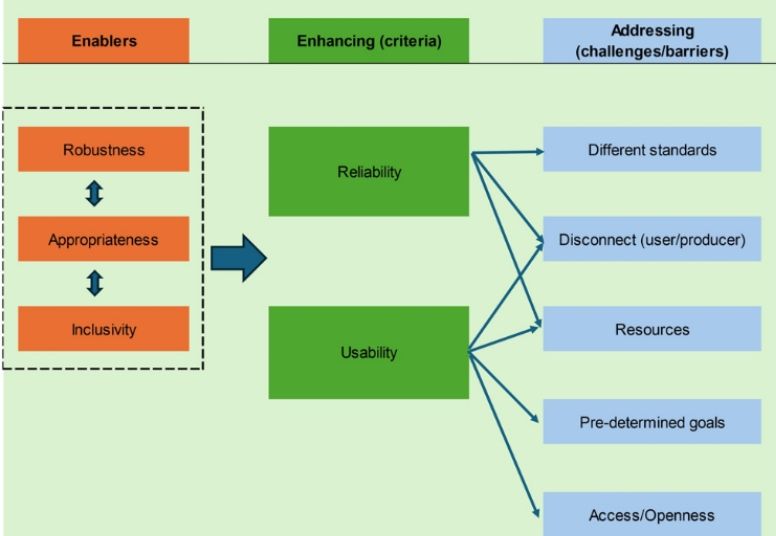
The article outlines the conditions under which SF can be recognised as a legitimate form of evidence. The authors develop a conceptual framework based on three enablers: robustness, appropriateness and inclusivity.
When SF outputs are designed with these factors in mind, they can meaningfully complement other forms of evidence.
The use of strategic foresight
Strategic foresight (SF) is explained as a participatory and future-oriented approach that develops actionable insights from the analysis of long-term trends and emerging risks. It is underpinned by methods such as horizon scanning and megatrend analysis that identify drivers of change to develop future scenarios.
Governments are growing their future-oriented capacities and SF can influence policy development. However, uptake of SF has not reached its full potential. There are questions about its evidential role and legitimacy. This is particularly in relation to how future scenarios are constructed and the role of participant perspectives and assumptions.
Challenges of evidence use in policymaking
Evidence is conceptualised differently across disciplines and policy domains. The level of reliability and objectivity needed for policymaking means that quantitative methods typically have been prioritised over qualitative methods such as focus groups or interviews. This is due to the perceived impact of value-laden judgements on their design and delivery.
In contrast, “gold-standard” quantitative approaches such as randomised control trials are considered to have higher internal validity as they can control for biases. They also provide reproducible results. This concept of a hierarchy of evidence can limit the types of evidence considered reliable for policymaking.
A second challenge relates to how evidence can be translated into actionable insights for policy. Traditional views of research quality based on replicability clash with values emphasised in co-production such as inclusion. Institutional and structural barriers are also recognised as challenges.
There can be a disconnect between evidence producers (researchers) and evidence users (policymakers). These communities can have distinct values, communication styles and timelines, leading to misalignment. This limits how evidence is meaningfully understood and used.
Good evidence needs to overcome these challenges. It needs to:
be relevant to the policy’s goals
be contextually valid
come from a recognised research method, which can include qualitative studies, observational data, and quantitative methods.
Strategic foresight and evidence use
SF also faces a range of challenges from an evidence perspective. These include:
standards challenge: the SF landscape is characterised by a lack of agreed quality benchmarks. Its reliability is also seen as less certain due to the complexity and future-oriented nature of the data.
translation challenge: a gap exists between SF outputs and actions. Some SF outputs such as narrative scenarios may not directly translate into immediate policy actions.
transparency challenge: low levels of futures literacy can limit users’ ability to understand and interpret SF evidence.
structural challenge: time constraints and resource scarcities can be barriers to participation as SF processes can require engagement over days, weeks and even years.
Strategic foresight enablers
The article proposes of three enabling factors to overcome the challenges outlined above.
Robustness and whether evidence is produced through methods that are explicit, contestable, and resilient to contextual variations. This a key enabler to address the standards and the transparency challenges. Robustness should ensure that foresight evidence is not overly dependent on narrow assumptions or single models. Instead, evidence gains credibility by being tested against multiple possible futures, reducing the risks of bias or fragility in decision-making.
Appropriateness tackles the translation and structural challenges involved in planning, managing, and delivering foresight exercises and in the use of their outputs. Appropriateness as an enabler stipulates that SF projects must be tailored to local circumstances and fits contextual needs.
Inclusivity addresses the standards and transparency challenge. SF exercises should consider the demographic and professional profiles of participants and whether methodological choices or how issues are framed may favour certain groups and exacerbate bias.
Figure 1 presents the conceptual framework that highlights the relationships between the three enablers and the related challenges:
The bottom line
SF does not replace traditional forms of evidence, and it does not necessarily yield standalone policy recommendations. It is as a complementary form of evidence, one that requires openness about its methodology to guide more impactful applications.
SF’s strength is that it helps policymakers think further ahead and consider a wider range of possibilities. The recognition of SF as reliable and usable evidence for policy will depend on how it is produced
Want to read more?
Evidence for the future? Strategic foresight as a source of evidence for policymaking - Laura De Vito and Gaia Taffoni, Policy and Society, May 2026