How government and community can share decision-making

Governments are seeking different ways to address increasingly complex policy issues. This includes facilitating collective decision-making between government and other stakeholders. This is known as co-governance. Effective co-governance arrangements can be difficult to establish and resource, and time-intensive to implement.
An article in the Australian Journal of Public Administration presents a model for implementing co-governance. Relevant to both government and non-government organisations, the model maps out a process to establish, implement and monitor co-governance. It also identifies the enabling factors such as relationship management, resources, trust and time.
A framework for co-governance
Co-governance (government and community sharing decision-making) is being used to respond to complex issues but is not well understood. The article uses the following definition of co-governance:
A governing arrangement where one or more public agencies directly engage non-state stakeholders in a collective decision-making process that is formal, consensus-oriented, and deliberative and that aims to make or implement public policy or manage public programs or assets.
It involves the following four stage process:

Figure 1: The four-stage process of co-governance
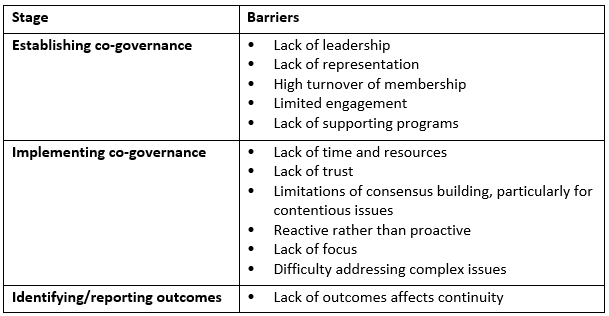
Barriers to implementing co-governance
Barriers can be experienced at the following stages of the co-governance process.
About the research
Three case studies were used to further develop the conceptual model of co-governance. These were:
an established place-based initiative that sought to resolve complex social and health issues associated with the redevelopment of social housing.
a national time-limited initiative that established co-governance of the National Disability Data Asset to ensure the asset has a social licence to operate.
an Aboriginal-led initiative in regional NSW that aims to improve outcomes for families and children in the area.
A comprehensive updated model
The research findings were used to develop an updated comprehensive model of co-governance relevant to both public sector and community stakeholders. The process of co-governance was reduced to three key stages - establishing, implementing, and measuring outcomes - and supported by other enabling factors.
Establishing co-governance
Six components are outlined in the new model:
mapping the system, context, and history and identifying stakeholders
meaningfully engaging with stakeholders to define scope and objectives that form a shared understanding and commitment
identifying the mechanism that enables stakeholders to become members and participate
enabling delegation of decision-making
appointing skilled leaders; and
establishing a secretariat to facilitate implementation.
Implementing co-governance
The updated model includes strategic and operational implementation, and a new component of monitoring the health/functioning of the arrangement. This involves checking the health of the co-governance group—its strategy, its implementation, and the health of the group itself in terms of membership and function.
Measuring outcomes from co-governance
The updated model includes measuring outcomes based on the reasons for establishing/engaging in co-governance. These include:
substantive outcomes: ability to achieve better outcomes together
normative outcomes: being the right thing to do
instrumental outcomes: the process being more important than the outcomes in increasing legitimacy and trust.
The updated model also includes indirect outcomes from co-governance. For example, participation in co-governance can build trust and understanding which can be translated into other contexts.
Enabling implementation
Several factors were identified as enabling implementation. Organisational and managerial support is required for individuals to participate in co-governance. This requires resources which may/may not be available from existing resource allocations. Data is critical across the process to identify priorities and measure success of activities and the overall arrangement.
Time is also critical. The co-governance process takes time to establish and there is value in not rushing as the process itself can be instrumental in building trust. Trust is recognised as a fragile concept in co-governance. The absence of trust, or the need to build trust (or social licence), may be instrumental in initiating a co-governance process. Equally, a baseline level of trust may be necessary for stakeholders to engage in the process
The bottom line
The updated model is depicted in Figure 2.
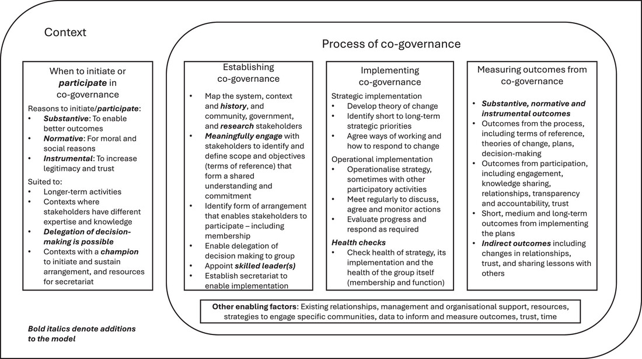
Figure 2: Model of co-governance
This model clarifies the conditions under which co-governance is most suited, distinguishes between its establishment and ongoing implementation, and makes visible the work required to sustain it over time. This is important given that co-governance may be implemented for different reasons, appears suited to long-term issues, and requires significant investment to establish and implement.
Want to read more?
Developing an evidence-based model to implement co-governance - Shona Marie Bates, Ciara Smyth, Ilan Katz, Bingqin Li and Fiona Haigh, Australian Journal of Public Administration, April 2026