The use of generative artificial intelligence (GenAI) has unlocked new capabilities and changed how content and services are created, shared and consumed. An article in Policy and Society lays the foundation for understanding GenAI and its key risks. It then examines the governance challenges of Gen AI and outlines a framework for its governance, emphasising the need for adaptive, participatory and proactive approaches.
GenAI can be defined as a category of AI systems that create new content (text, images, audio, or video) based on inputs and leveraging machine learning. These systems use enormous datasets to learn patterns. In turn, they use them for generating new outputs.
Many of the previous AI systems were rule based and addressed predefined tasks. GenAI systems rely more on their training data and work autonomously in creating their response. They also have the capability to create new content, resulting in unexpected outcomes.
GenAI risks include:
- Hallucination and inaccuracies: where the system produces fabricated or incorrect results.
- Jailbreaking: the process of manipulating the model to bypass its built-in guardrails (e.g., safety measures, ethical guidelines) to elicit responses from the model that under normal conditions it would refuse to provide.
- Data training and validation risks: Reliance on unfiltered internet data can result in the incorporation of biases, propagation of misinformation, and infringement of privacy rights.
- Opacity risks: GenAI models operate as black boxes as it is unclear how they arrived at their outputs. This makes it difficult to trace their decisions, ensure accountability and consequently build trust in them.
- Control risks: GenAI systems can operate at different levels of autonomy. This results in varying levels of difficulty in regaining control of such systems during malfunctions.
GenAI raises a diverse set of complex governance challenges that extend well beyond engineering of the systems themselves. Addressing these challenges requires a comprehensive approach to safeguard citizens and ensure society benefits from generative AI while mitigating its negative and/or unintended consequences.
Governance challenges include:
- Data collected from the internet without permission which raises intellectual property, copyright, and fairness concerns.
- The spread of misinformation and disinformation with GenAI’s ability to rapidly create realistic media.
- The potential for fraud and cybercrime as malicious actors can deploy media generated by GenAI, raising concerns for individuals’ safety, national security, and cybersecurity.
- Societal impacts and the future-of-work challenges such as the impact on the creative industries and the wider labour force due to automation.
Governments need to be more proactive and adaptive in governing AI and make the process more participatory. This requires capacity building within the public sector, regulatory innovations, and taking actions to protect citizens and democratic values in the face of the technological disruptions.
The use of regulatory sandboxes and pilot programs could provide a safe and controlled environment for experimenting with GenAI, helping regulators understand practical challenges and adapting regulations iteratively.
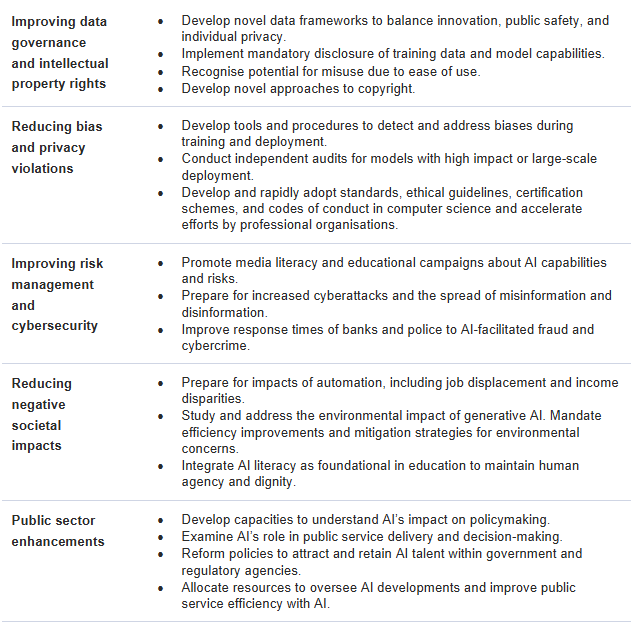
The article outlines a comprehensive governance framework with key actions and recommendations. This includes:
The bottom line
There are complex legal, organisational, political, regulatory, and social challenges in governing GenAI. This requires innovative governance approaches that are adaptive, inclusive and aligned with societal values. Governance is also critical to ensure ethical and responsible use with risks are not simply transferred from the technology sector to society and governments.
Want to read more?
- Governance of Generative AI - Araz Taeihagh, Policy and Society, January 2025
Each fortnight The Bridge summarises a piece of academic research relevant to public sector managers.