The Government of Ireland’s recently released Policy Handbook for public servants – a ‘real world guide for policy development’ – draws heavily on the 5D Model of Policy Advice, developed by ANZSOG Practice Fellow (Policy Capability and Public Management) Sally Washington, and her work with Irish civil servants.
This article, by Barry Vaughan, Department of the Taoiseach (Irish Prime Minister’s Department), outlines the handbook’s development and ANZSOG’s role in shaping its model of the policy process.
Providing high-quality advice to ministers is a core competence for civil servants. Ireland has recently undertaken a programme to improve its policy making system. Improvements are based on a three-pillar approach to policy focused on ‘evidence, feasibility and legitimacy’, and supported by a new Policy Handbook with a staged approach to the design and delivery of policy advice¹.
In a purely rational world, policy making would advance via a sequence like the following: assess relevant data and evidence; utilise this information to set out a list of policy options for decision; move on to implement the preferred option; and communicate the success of this initiative at some later date. These assumptions underpin what has become known as the ‘what works’ movement where the civil service was urged to be guided solely by systematic evidence in making its recommendations to government.
However, the belief that evidence alone could guide policy development to clear and undisputed choices has waned. Evidence is still vital, but there are other fundamental imperatives impressing upon policy making and policy success.
One of these is urgency, the imperative to ‘deliver’ quickly and just ‘get things done’. For example, Ireland’s Programme for Government 2025 proclaims that ‘the goals that we have set are ambitious and they will be matched by a tireless focus on delivery’. Civil servants must develop policies with an emphasis on feasibility – the ability to action policy solutions – and to ensure that they produce positive and substantive outcomes for people.
Alongside this focus on feasibility is an increasing realisation that the public must be involved in the formation of policy. Policy solutions need to be accepted as ‘legitimate’. This is not only for intrinsic reasons - OECD research demonstrates that ‘having a say’ is highly correlated with trust in national governments² - but also for extrinsic reasons, as many desirable policies like those related to climate action cannot be achieved without people actively changing their lifestyles.
These three fundamental pillars of policy – evidence, feasibility and legitimacy – have been evident in some of the most prominent examples of policy success in Ireland (such as the national cancer strategy which resulted in a significant improvement in survival rates). However, it is important to understand that adhering to these pillars is not done in a linear, sequential fashion whereby evidence points to a policy response which is then delivered and only then ‘sold’ to the public. Each pillar continuously reinforces the others. Successful implementation depends on continuous communication which, in turn, is informed by well-marshalled evidence. Feasibility is conditioned by legitimacy which depends on robust evidence.
Analysis of policy successes in Ireland revealed that policy development does not always proceed on a consistent basis across government. To encourage more consistency, and to build on the lessons from policy successes, the most senior cadre of civil servants in Ireland, the Civil Service Management Board (CSMB) sponsored the development of a policy handbook. The Handbook is designed to guide civil servants from the initial stages of assessing demands and evidence through to recommendations to government and delivery. The three pillars of evidence, feasibility and legitimacy serve as the fundamental architecture of the handbook.
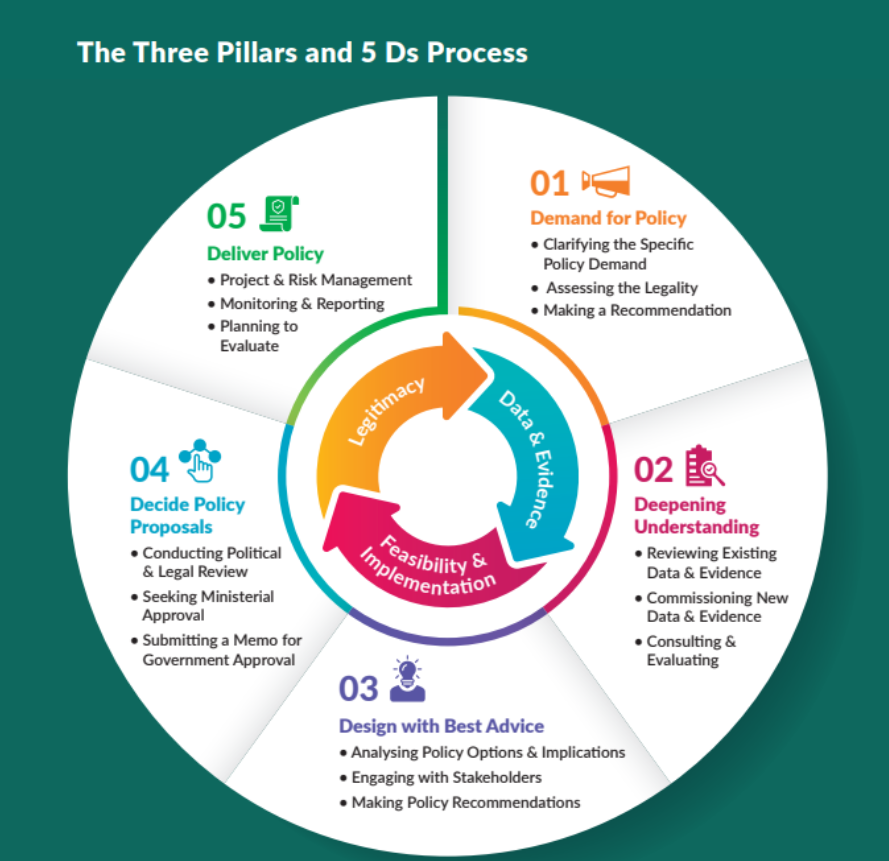
Figure 1. The Three Pillars and 5 Ds Process
In terms of a consistent model to guide policy processes, the handbook draws on and adapts ANZSOG Practice Fellow Sally Washington’s 5D policy model.³ In presentations to Irish civil servants as part of an OECD assessment of Ireland’s policy making systems, Ms Washington invited us to use her material or “steal with pride” to adopt and adapt innovations and lessons from other jurisdictions.

Figure 2: Washington’s 5D Model of Quality Policy Advice⁴
Both the original, and Ireland’s adapted 5D model, stress the importance of continuous engagement and evaluation, seen as a continuous activity rather than a discrete process. At various stages, policy advice can benefit from external input whether it be at the design or delivery stages or others. And an evaluation mindset should be maintained throughout rather than being an afterthought following delivery.
Of course, a handbook is only a tool, and policy is developed in a much broader environment. This is why we have also adopted Sally Washington’s notion of a policy infrastructure which points out that we need to concentrate on the following facets if we want to uplift policy capability across the board⁵:
- Leadership—to ensure the organization or whole-of-government system is focused on policy priorities while also investing in the ongoing health of the policy function.
- Policy quality systems—the tools, methods, and processes to ensure the provision of quality advice to decision makers, as included in the Policy Handbook.
- People capability—making sure policy professionals have the right skills and are supported in their work and development.
- Engagement—ensuring that a diverse range of people and perspectives are involved in the development of policy advice.
This notion of a policy infrastructure has been extremely useful in highlighting the distinct but mutually reinforcing elements involved in fortifying policy capability. It helps to avoid focussing on just one element, such as training, which, on its own, is unlikely to uplift policy capability.
Public management scholars have pointed out the difficulties, tensions and possible trade-offs involved in attempting broad systematic change. Having a compass (the three-pillar approach for essential orientation) and a map (the 5D process) will not on their own make change happen. But the approach outlined here provides a vital starting point on the ongoing journey for improved policy making in Ireland. The journey is supported by advice from fellow travellers and experts from other jurisdictions such as from New Zealand and ANZSOG.
- ANZSOG Practice Fellow, Sally Washington, gave the keynote address at the launch of the Irish Policy Handbook. This article is based on her address: Putting the Public into Public Policy: Engaging for Better Decision Making | ANZSOG
- Video of the Irish Prime Minister’s address
- Video of Sally Washington’s keynote
References
¹ https://www.gov.ie/en/department-of-the-taoiseach/campaigns/policy-handbook-a-real-world-guide-to-policy-development/
² https://www.oecd.org/en/publications/oecd-survey-on-drivers-of-trust-in-public-institutions-2024-results_9a20554b-en.html
³ See Washington, S. (2004), https://apolitical.co/solution-articles/en/how-to-deliver-great-policy-advice
⁴ Walker, C. and Washington, S. (2025) ‘Guiding the Provision of Quality Policy Advice’, Policy Design and Practice: Vol 8, No 1, 1-14
⁵ Washington, S. (2023) ‘An Infrastructure for Building Policy Capability – Lessons from Practice’, Vol. 6 (3): 283-98, https://www.tandfonline.com/toc/rpdp20/6/3