"We talk about partnership, we talk about engagement, but are we really clear on what that means?"
– Lil Anderson - Chief Executive,
Te Arawhiti- Office for Māori Crown Relations, NZ, speaking at last year's conference
The past 12 months have been difficult for many, not least partnerships between Indigenous agencies, communities and governments. While many have been challenged, genuine partnerships built on foundations of trust and respect have not only survived but been agile, innovative and even strengthened through the environmental trials and the COVID-19 pandemic. Qualities that have resulted in a different and successful post-COVID recovery, require detailed exploration.
The Proud Partnerships in Place: 2021 ANZSOG First Peoples Public Administration Virtual Conference will unpack and celebrate the successes we are already seeing across Australia, Aotearoa-New Zealand and internationally. It will also challenge participants to think beyond the way things have always operated, to consider how First Peoples knowledge, local community decision-making and new relationships with government and the public purpose sector can be mobilised to meet the needs of communities.
Governments and First Peoples are working together on treaty, well-being budget initiatives, voice, recognition, land management, health and social service issues that all require authentic partnerships, to solve local and global challenges. This work constitutes a resetting of relationships and will determine a new course for how First Peoples and government agencies work together into the future. The conference will provide an opportunity to examine how local knowledge can address global challenges in the face of increasingly constrained resources, threats to the environment and the disproportionate impact of these events on First Peoples communities.
For frequently asked questions (including pricing) please see here.
Please note: registrations will continue to be open during the conference (17 February 2021 - 10 March 2021). Delegates will receive live access to events depending on when they register. For example, if they register after the first event, 17 February 2021, they will receive live access to events 2-4 in addition to exclusive access to recordings/resources from the first event.The past 12 months have been difficult for many, not least partnerships between Indigenous communities and governments. While many have been challenged, genuine partnerships built on foundations of trust and respect have not only survived but been agile, innovative and even strengthened through the environmental challenges and the COVID-19 pandemic. Qualities that have resulted in a different and successful post-COVID recovery, require detailed exploration.
The Proud Partnerships in Place: 2021 ANZSOG First Peoples Public Administration Virtual Conference will unpack and celebrate the successes we are already seeing across Australia, Aotearoa-New Zealand and internationally. It will also challenge participants to think beyond the way things have always operated, to consider how First Peoples knowledge, local community decision-making and new relationships with government and the public purpose sector can be mobilised to meet the needs of communities.
Governments and First Peoples are working together on a range of treaty, well-being budget initiatives, voice, recognition, land management, health and social service issues that all require authentic partnerships, to solve local and global challenges. This work constitutes a resetting of relationships and will determine a new course for how First Peoples and government agencies work together into the future. The conference will provide an opportunity to examine how local knowledge can address global challenges in the face of increasingly constrained resources, threats to the environment and the disproportionate impact of these events on First Peoples communities.
ANZSOG invites Indigenous community organisations, government agencies, academics, not-for-profits and the private sector to attend the virtual conference from 17 February to 10 March 2021, across four consecutive Wednesdays 11.30am - 2.30pm AEDT.
The conference will take place virtually, using leading technology from OnAir to provide a safe environment either at the office, a community venue, your home or your preferred device while on the road, for honest discussions and encourage positive contributions relating to the future of First Peoples public administration in Australia and Aotearoa-New Zealand.
The conference program is currently under development, but will include a keynote address from a prominent Indigenous speaker, plenaries and panel discussions with distinguished speakers and international Indigenous leaders. Virtual breakout sessions with speakers will enable you to move between sessions and be inspired by distinguished public sector, community and academic representatives.
Networking sessions will also be available where attendees can choose and schedule several one hour ‘pre-event sessions’ and move effortlessly between a range of virtual meeting hubs to catch up in an informal virtual setting.
Please check the ANZSOG website for further program information closer to the date. Conference attendees will be notified as speakers are confirmed. Early bird, group and community discounted pricing is available upon registration.
Conference delegates will be given access to the event portal url via email prior to 17 February 2021.
This is the third ANZSOG First Peoples Public Administration Conference, delivered in partnership with National Indigenous Australia Agency (NIAA). The 2017 and 2019 conferences provided an opportunity for the public sector, community organisations, not-for-profit representatives and academics to explore new approaches to First Peoples public administration.
For more general conference information please review the FAQs below.
For enquiries please contact Sharon Nelson-Kelly, Senior Advisor, First Peoples Program and Strategy firstpeoples@anzsog.edu.au.
Join the conversation using #FirstPeoples2021
View previous conference conversations here:
- 2019 Reimagining Public Administration + the official conference video
- 2017 Indigenous Affairs and Public Administration: Can’t we do better?
Indigenous models of governance and political organisation are some of the oldest and longest continuing in the world and are a foundation for our understanding of distinctly Australian and Aotearoa-New Zealand governance models. Developing a First Peoples strategy recognises the impact of colonisation on Indigenous peoples, and the long history of government policies and actions that have disadvantaged and discriminated against First Peoples in both Australia and Aotearoa-New Zealand. ANZSOG’s Strategy 2025 commits to “working with communities across Australia and New Zealand to promote and prioritise the perspectives and contributions of First Peoples”. The ANZSOG First Peoples Strategy builds on this commitment.
Enquiries
For any enquiries about the 2021 First Peoples Virtual conference…
For any enquiries about the 2021 First Peoples Virtual conference, please contact Sharon Nelson-Kelly, Senior Advisor, First Peoples Program and Strategy (firstpeoples@anzsog.edu.au).
Stay informed
- Conference hashtag: #FirstPeoples2021
- Follow ANZSOG on Twitter: @ANZSOG
- Follow NIAA on Twitter: @indigenous_gov
- Subscribe to Indigenous News - ANZSOG's newsletter for Aboriginal and Torres Strait Islander peoples and Māori
Sponsorship
Proud Partnerships in Place offers a unique opportunity for local, national and global exposure to promote your organisation, as well as demonstrate your support and commitment to better outcomes for Indigenous communities. This includes wider recognition through pre and post-conference promotions.
For more information on ANZSOG, our commitment to First Peoples, and our unique sponsorship opportunities and benefits, please download our Sponsorship Proposal.
Please contact us at firstpeoples@anzsog.edu.au if you have any further questions.
Conference sponsors
"Meaningful collaboration is central to our work, and we cannot have real improvements in health care for Aboriginal and Torres Strait Islander people without building long-term partnerships with Indigenous communities. This conference is an opportunity for us to support a forum that will share the stories of success that are already happening across Australia and Aotearoa-New Zealand, and help build stronger partnerships for the future.”
- Adjunct Professor Debora Picone AO, Chief Executive Officer, Australian Commission on Safety and Quality in Health Care
About the artist
ANZSOG’s upcoming Proud Partnerships in Place: First Peoples public administration virtual conference will feature original Māori and Aboriginal artwork designed to inspire attendees and represent the journey ANZSOG is undertaking to work with First Peoples and incorporate their knowledge and culture into all aspects of our work.
ANZSOG Dean and CEO Ken Smith said that ANZSOG had featured Indigenous artwork in all three of its First Peoples conferences in recognition of the essential nature of story telling, art and creativity to Indigenous cultures.
“Proud Partnerships will be about exploring the many strengths and deep knowledge in Indigenous communities and how governments can build genuine partnerships which harness those strengths to drive change,” he said.
“This beautiful artwork illustrates the journey we are on, and what we are trying to achieve through our First Peoples conferences – events that build connections and provide a vital forum to share the aspirations and successes of First Peoples.”
The commissioned artwork ‘Te Haerenga’ (The Journey) has been produced by Māori artist Aaron McTaggart (Te Arawa – Ngati Whakaue, Ngati Rangi Wewehi) who was born in Rotorua, New Zealand and has been living in Sydney for 17 years with his whanau (family). He has exhibited in many galleries in Australia and was a feature artist in the ‘Pasifika’ Exhibition at the Casula Powerhouse Museum in Sydney in 2014.
Te Haerenga (The Journey) - Aaron McTaggart
His work is a contemporary interpretation of Māori art forms used in Raranga (weaving) including Harakeke (flax), Tukutuku (decorative woven panels used to adorn the walls of a Māori meeting house to record their history) and Ta Moko (tattoos, a visual story which connects the person to their Whakapapa (genealogy) and Māoritanga (culture). Mr McTaggart says he endeavours to put Wairua (spirit) and Aroha (feeling) into every visual interpretation, to bring a fresh perspective to tell the story.
He said that Te Haerenga told a stylised story blending Māori history and ANZSOG’s mission to improve government.
“This stylised story begins in the top left corner when Māori arrived in Aotearoa-New Zealand and Marama (moon) illuminated Te Po (darkness) and past descendants guided our Tupuna (ancestors) to navigate the ocean to discover Aotearoa (land of the long white cloud),” he said.
“Underneath this, the brow of the Waka (canoe) represents Māori embarking on the epic journey to become Tangata Whenua (first people of the land). The green at the bottom left is the fertile land of Aotearoa, representing the balance of nature and knowledge of Māori to provide food and medicine for generations, to sustain their Iwi (tribes), Hapu (sub-tribes) and Whanau (families).
“The two blue sections at the top represent the Wai (water) between Australia and New Zealand, and while it keeps us apart - water is the essence of all life and pays homage to the Mauri (life force) that strongly connects Māori, Aboriginal and Torres Strait Islander People to water.
“At the top, is a brown and red Koru (a symbol of new growth, new beginnings, new relationships) that is surrounded by light blue lines with a red centre. The other black and yellow Koru encompasses Māori Tikanga (customs and protocols) that keep Māori connected to their identity. Inside the Koru, community is the focus - people living and working together to achieve better outcomes for their Tamariki (children) and ultimately our communities.
“The brown ‘fields’ in the bottom right represent the culture, perspectives and values of Aboriginal, Torres Strait Islander People and Māori, that can better inform the work of the public sector, academics and community agencies.
“The green section on the right hand side represents the environment and how essential it is for the wellbeing of all First Peoples cultures. Beneath this, the brown and red earth of Australia depicts the critical importance of caring for Whenua (land/country), to the generations of Indigenous Kaitiaki of the land.”
“In the centre, the small black and red triangles inside the white curved line, symbolise the steps ANZSOG has taken since it began its journey in 2002.
He said the journey and milestones ANZSOG has achieved thus far are illustrated beneath the steps. The grey pathway that moves beyond these milestones signifies the journey ahead and the achievements and stories yet to unfold.
“The cross hatch design in the bottom right depicts the reward that is nurtured and reaped through education. The purpose of ANZSOG is paramount, to continually provide the public sector, academics and community leaders with the knowledge to develop the best public administration tools to achieve the best outcomes for all First Peoples.”
For its 2019 First Peoples conference Reimagining Public Administration, held in Melbourne, ANZSOG commissioned an original artwork – “Journey – where we have been & where we are going” - from local Indigenous painter Emma Bamblett. The artwork will be used again as part of promotions for Proud Partnerships.
Journey – where we have been & where we are going - Emma Bamblett
A proud Wemba Wemba woman, born and raised in Echuca on the Murray River, she has found inspiration and motivation from the arts community in Melbourne as well as working in the Aboriginal child and family welfare sector. "Journey" represents coming together, journey and connection - all themes of the Reimagining Public Administration conference.
Most of Ms Bamblett's artwork is deeply personal, representing the stories and struggles for vulnerable children, youth and families through whom she meets in her occupation.
Aaron McTaggart and Emma Bamblett
She said that the painting was a ‘representation of where we have been and where we are going’.
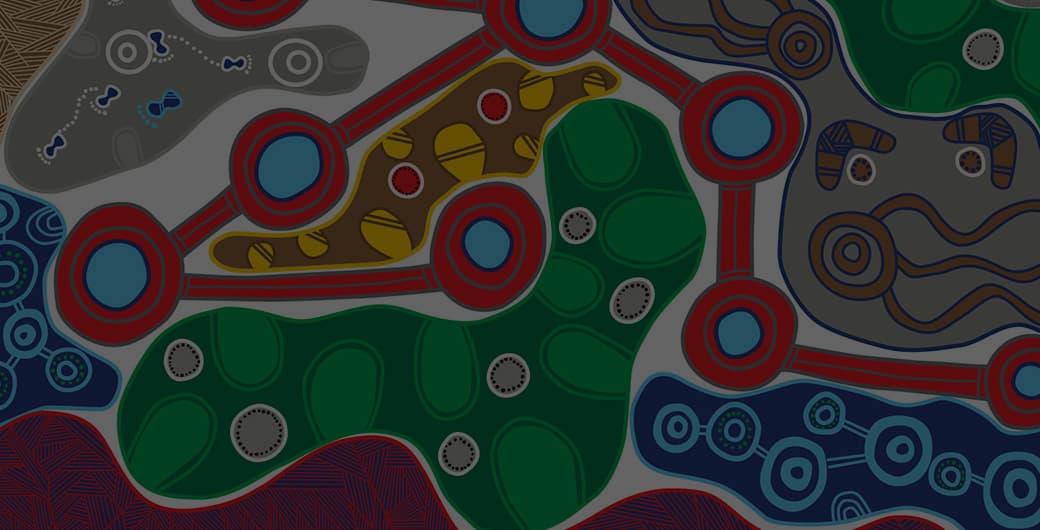
“You will see bright colours of red and yellow in the rivers, with continuous lines to represent the rivers which surround the area where the conference was held,”
“The footsteps in the top left corner represent the role of ANZSOG in providing leadership, support and guidance to those working in the public sector.
“The brown areas with the yellow hills represent Aboriginal and Torres Strait Islander people, the dots in the middle of the circles represent their skin colour and the red represents the earth, while the green area with the hills and grey circles represent Māori -the First Peoples of New Zealand.
“The hills signify the importance of land and country and the importance of connection.
“All the elements in this painting represent coming together, journey and connection. I believe these are elements which are representative of ANZSOG’s mission to support and provide leadership to the public sector and provide effective outcomes for our community.”


